
In most plants, the conversation about performance starts with equipment and process. Leaders invest in faster lines, better changeovers, and tighter controls, and assume that people-related issues will sort themselves out if the process is strong enough. But through our work in dozens of facilities, we have seen the opposite pattern. The biggest swings in stability, output, and quality often come from how plants manage their people, not from the machines they run.
By Ozan Ozaskinli, Jordy Lemus, and Sercan Aldatmaz
1. Introduction
Food manufacturing is full of opportunities to boost capacity, reduce waste, and stabilize performance, yet many plants struggle to make meaningful progress. As outlined in previous articles of this series, the biggest barriers are often not equipment or technology but the misconceptions that quietly shape how work is managed across six dimensions: Process, Physical Assets, People, Governance, Systems & KPIs, and Planning. Each article in this series challenges a separate set of assumptions that limit performance and reveal where capability is hiding in plain sight.
Where Part 1 focused on misconceptions about process optimization, Part 2 shifts the focus to people, the most overlooked driver of operational performance. These beliefs influence who stays, who learns, how teams are staffed, and how supervisors lead. They feel practical because they have been repeated for years, yet they quietly limit capability, reduce resilience, and create the very instability plants try to eliminate.
This section unpacks the people-management misconceptions that hold operations back and shows how rethinking them creates a foundation of stability that even the best-designed processes cannot achieve on their own.
Misconception 1: “Running lean means running tight, one extra person is waste.”
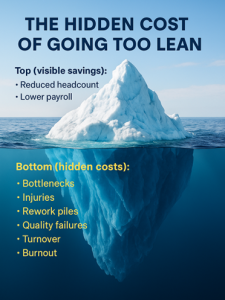
When margins get thin, this is often the first reaction. Labor is the most visible cost, and trimming headcount feels like immediate efficiency. The lines still run, orders still ship, and payroll drops, so it looks like the move worked. But those “savings” hide a bigger truth: you didn’t make the process leaner; you just removed the buffer that kept it stable.
The first thing you lose isn’t cost, it’s capacity. Removing people shifts the bottleneck from equipment to humans. A packaging station designed for three operators becomes a two-person job on paper and a one-person job whenever someone is sick or pulled away. The line can only run as fast as the most overloaded point. When the right number of people is restored to the true constraint, output jumps. In our work we’ve seen what looks like a 5–10% increase in headcount at key stations unlock 15–45% more sellable output, simply because the bottleneck moves off one exhausted operator and back to a machine you can plan around.
Reduced staffing also amplifies risk. Heavy lifts and rushed cycles fall onto fewer people, increasing the likelihood of injuries and threatening the few operators who understand critical tasks. Quality and food safety checks get squeezed into the breaks, so labs and line leaders start taking shortcuts: tests are rushed, documentation is filled in later “from memory,” marginal product gets the benefit of the doubt. Supervisors spend their days firefighting instead of managing flow, which is how twenty pallets end up mislabeled and an entire shift is lost to rework. None of this shows up in the neat headcount savings spreadsheet, but it appears in downtime, claims, complaints, and rising turnover.
We saw all of this come together in one plant that “tightened up” packaging and lab staffing at the same time. A station originally designed for three people became a one-person post whenever someone was absent. One exceptionally strong operator masked the flaw until the day he took his daughter to college. His replacement could not keep up. Cases backed up, people were pulled from other posts to help “for a bit,” labels were rushed and by midday no one wanted to be anywhere near that station again. No one got formally injured, but the job became toxic: operators avoided it, some left rather than be rostered, and HR tried to plug the hole with temporary workers who rarely lasted a week.
The lab experienced the same strain. With one fewer technician, the remaining person could not keep pace with cook checks, micro tests, and documentation. Corners were cut. One batch that should have failed micro still made it onto a truck. Meanwhile, a packaging oversight caused twenty pallets to be stripped and repacked because no one had time to confirm a customer-specific requirement.
When the situation was mapped with the team, the pattern was obvious. The slow replacement operator, the quality slip, and the rework were not random events. They were the inevitable consequences of running a risk-sensitive process with too few people and no buffer. The cuts did not make the plant lean. They lowered its true capacity, increased exposure to injury and quality failures, and made daily work harder to execute correctly.
In our projects, performance improves when plants stop equating lean with the smallest possible headcount and start staffing according to the actual work. We rebuild staffing at heavy and quality–critical stations and add a small, cross-trained flexible core to absorb routine variation. The results are consistent. Bottlenecks shift back to equipment, output rises 20-30% on the same assets, rework and repacks decline, and checks are completed without heroics. Absenteeism and turnover fall because the job no longer feels punitive. Even though payroll increases compared to the cut-to-the-bone version, cost per unit drops because the plant avoids the hidden tax of lost capacity, high waste, safety risks, and damage to reputation.
When work is designed to run this tight, the strain doesn’t stay on the line. It shows up in who burns out and who walks out the door.
Misconception 2: “Turnover is just part of this industry, since we pay market rate and the job isn’t that hard.”
Many leaders in food manufacturing accept high turnover as a cost of doing business, pointing to regional wage competition or the realities of hourly rate. The thinking goes: If we’re paying market rate and offering standard benefits, what else can we do? People come and go.
But turnover rarely boils down to pay alone. In our projects, we’ve found that real drivers are often hiding in plain sight: unclear responsibilities that make roles feel unbalanced, workloads that push into physically taxing territory without recognition, unstable schedules that destabilize life outside the plant, and a lack of visible progression that makes people feel stuck. Employees don’t expect luxury, but they do expect stable schedules, consistent tasks, and acknowledgment that their work matters beyond the paycheck. Too often, facilities undermine those basics by shifting expectations weekly or adding duties without adjusting compensation, training, or support. The disconnect drives good people out the door.
Often the reasons behind turnover are not examined deeply enough to drive real corrective action. As a result, plants fall into a familiar loop: they replace departing staff with temporary workers or first-timers, retrain from scratch, relearn the process adjustments the previous team had mastered, repeat the same errors that come with inexperience. The gaps are then patched with overtime or quick fixes, leading to more deviations, non–conforming batches, and a fragile operation held together by whoever showed up that day.
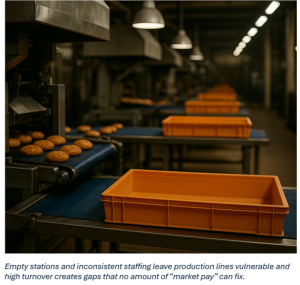
We saw this pattern in a bakery plant where supervisors blamed “unreliable workers” while turnover sat at 45%. Digging deeper, the significant issues were scheduled for Thursday for the next week, making it nearly impossible for people to plan childcare, second jobs, appointments, or any kind of routine. There was also no path beyond “senior operator,” even after five years. People weren’t leaving for fifty cents more an hour; they were leaving for predictability and fair growth opportunities. After implementing four-week published schedules and conducting workload audits, turnover fell from 45% to 22% in nine months, temporary reliance dropped 60%, and error–related waste decreased by 25% as experience stayed in the building.
If turnover feels inevitable, it’s a symptom of deeper imbalances in how you value and support people. Fix those and watch your retention stabilize to single digits.
Once leaders accept turnover as inevitable, they rarely examine whether the pay and progression system is reinforcing the problem.
Misconception 3: “Pay should be based on seniority; that’s the fairest way.”
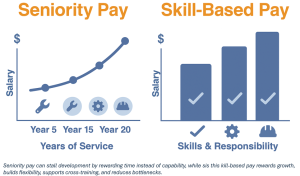
On paper, seniority-based pay feels simple: stay long enough, earn more. No debates, no complicated bands, no accusations of biases. But in most plants, the work has evolved while the pay structure has stayed frozen. The result is obvious: a new, highly skilled operator who runs the filler, checks cook curves, troubleshoots breakdowns, and owns quality checks earns less than a 20-year veteran whose daily task is loading a hopper. Everyone on the floor sees that the harder, more technical work is paid less.
This mismatch is not an “engagement issue.” It is a structural risk.
First, it removes any incentive to learn. If the easiest job on the line pays more than the toughest one, the rational move is to stay put. Cross–training stalls. Why add the cooker, the CIP, or another complex asset when it only increases pressure and does not pay? Skill depth collapses, and the talent matrix inverts: a small group carries all the high-stakes tasks while everyone else stays narrow.
Second, the system erodes backups. When only a few people ever reach higher skill levels, any absence, resignation, or retirement creates an immediate capability gap. Knowledge disappears the moment a senior person walks out because no one was motivated to follow behind them. Agency labor and emergency training become the norm because the underlying message is clear: learning more is not worth it.
Third, seniority-based pay creates a promotion path based on time rather than mastery. Strong operators don’t see, “If I learn X, Y, and Z, I advance.” They see, “If I wait ten years, I advance.” Your best people don’t wait. They leave for plants where skill is rewarded. You’re left with vacancies on your most complex posts, a constant training churn, and rising agency spend just to maintain basic coverage.
The long-term effect is a workforce that drifts into imbalance. Veteran employees cluster in the lightest roles because time, not competence, determines pay. The hardest, most technical stations are run by newer staff who quickly burn out and move on. Leaders eventually ask, “Why can’t we keep good people?” but by then the issue is systemic: pay has been disconnected from the real work for years.
In our projects, the turnaround begins when plants stop treating all operators as interchangeable and document the true load and complexity of each job. We rewrite job descriptions to reflect actual work, then build a live talent matrix showing who can do what today, not just who has been around longest. From there, we introduce skill-based pay bands. Your level is determined by capability and accountability, not tenure. Seniority still matters, but only within a band; it no longer overrides reality.
When this clicks, the results are immediate. Across our engagements, shifting from pure seniority pay to skill-based bands has increased the average number of fully qualified backups per critical machine from 1–1.5 to 3–4 in under a year. Voluntary turnover among top operators drops 25–40%. Agency spend falls 30–50% as internal capability deepens. Higher skill attainment doubles, and time to get someone to “run solo” on a key asset shrinks by 20–30% because development paths and incentives are clear.
When pay is disconnected from skill, there is little incentive to learn, and even less reason to make capability visible.
Misconception 4: “We don’t need a skills matrix our supervisors know their people.”
Many management teams downplay the need for a formal skills matrix because supervisors “know their people” and can usually assemble coverage in the moment. The logic feels efficient: why take operators off the line for structured training when you can simply call in the go-to person for each task? A formal system becomes something to build “later,” a moment that never arrives in a high-tempo plant.
But a “mental matrix” only works in calm conditions. It provides no clear picture of the team’s real capability: who is fully qualified, who is partially trained, where critical skills are concentrated, and who has been stuck in the same station for years. Over time, this invisibility creates structural issues: the same high performers keep accumulating skills, weaker operators never get a chance to grow, and shifts diverge in capability.
This fragility shows up in day-to-day operations. A single call-out can throw the entire shift off balance because no one else is trained to perform a critical setup. We’ve even seen cases where this dependency is abused: the “go-to” operator knows they’re indispensable and a few learn to leverage it. Supervisors scramble to fill gaps, and the entire operation becomes vulnerable to routine disruptions that snowball into hours of downtime and quality-related waste.
We saw this clearly in a confectionery plant where a veteran operator called in sick on a Friday night and no one else knew the oven recalibration sequence. Production halted for four hours, costing $15k in lost output and scrap. The deeper issue wasn’t absence; it was how skills were distributed. When we built the first real skills matrix, we discovered that 70% of advanced competencies were concentrated on day shift, three operators carried all critical setups, and half the team had no pathway beyond their current station.
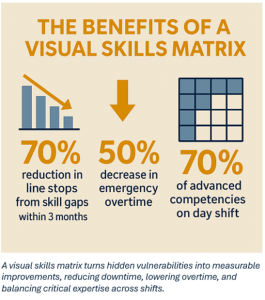
Once we clarified critical skills, built backups, and introduced a live visual skills board updated monthly, the change was immediate. Line stops from skill gaps dropped 70% in three months, emergency overtime fell 50%, and coverage became dependable instead of a nightly scramble.
If skills tracking lives in supervisors’ heads and cross-training happens only “when there’s time” the operation becomes weak, costly, and overly dependent on a few individuals. Make skill ownership visible, shared, and intentional, and you build a plant where lines stay running, teams stay balanced, and resilience becomes the default rather than the exception.
As skills remain undocumented and unevenly distributed, the burden of keeping the line running shifts quietly onto supervisors.
Misconception 5: “Supervisor is basically an admin role, managing paperwork and keeping the line running.”
In many plants, the supervisor role has quietly devolved into an administrative position. Instead of leading people and running the operation, supervisors spend hours buried in attendance sheets, quality forms, manual reports, and handwritten logs because the plant lacks even basic digital tools. On top of that, most supervisors are promoted not for leadership ability but because they were the best operators on the floor. They know the equipment, but often have no training in communication, coaching, conflict management, or decision-making. This creates a familiar pattern: overwhelmed supervisors, ineffective leadership presence, and no one truly owning the line.

But the real job of a frontline leader is far larger and far more valuable than “keeping the line moving.” A true supervisor owns the line end to end. They spot issues early, solve problems immediately or escalate with clarity, and ensure standards are followed every hour, not just when corporate visits. Instead of policing operators, they coach them. Instead of filling gaps on the fly, they develop talent and build a stronger team. When this role is performed correctly, it becomes the backbone of plant stability, safety, and morale.
The fix isn’t complicated, but it does require redesigning. First, eliminate the administrative burden that buries supervisors by giving them simple tools that automate reporting, headcount checks, and shift documentation; a single tablet can wipe out hours of paperwork. Second, stop using the “best operator” as the default candidate for leadership. Create two separate advancement tracks: one for technical specialists, and one for people leaders. This lets operators who love machines grow in their craft without being pushed into roles they’re unprepared for and allows true leadership potential to be selected and developed on purpose. Third, give supervisors a clear mandate: they are responsible for the performance, behavior, standards, and development of their team, not just the output of the machines.
When plants reset the supervisor role in this way, the impact is immediate. Leadership becomes visible again. Problems get solved earlier. Standards hold. Morale rises because operators finally have a supervisor who supports them instead of juggling paperwork. And the line stops relying on a few people to hold it together and starts running with repeatable discipline.
When supervisors are buried in admin and stripped of real ownership, the culture that emerges is not intentional. It is reactive.
Misconception 6: “Culture is managed by corporate or HR; operations’ role is to keep the line running.”
The early COVID crisis revealed just how costly that mindset can be. During the 2020 outbreaks, one of the largest meat processors in the United States, faced massive infections, worker protests, and more than $200 million in fines and settlements. The virus was part of the story, but the deeper cause was cultural. A long-standing “output above all” mentality pushed supervisors to ignore safety warnings, skip breaks to keep lines moving, and issue commands instead of listening. The Department of Labor cited the company for failing to protect workers. What should have been a difficult but manageable crisis spiraled into a reputational and operational disaster because culture was seen as someone else’s responsibility.
This mindset that culture belongs to HR while operations focus on “running the line” is common across plants. It doesn’t happen on purpose; it creeps in as daily pressures prioritize short-term output over long-term team health, allowing small behaviors to snowball into systemic issues. Even in plants with solid processes, these erosions can occur if leadership at every level (from supervisors to managers) doesn’t actively foster accountability, respect, and collaboration.
It often starts with how supervisors handle pressure. During a line stop, instead of explaining what happened and coaching the fix, a supervisor snaps at the team. A moment that should teach becomes a moment that shuts people down. Trust erodes. Once people flinch instead of contributing, the next slide is predictable: blame replaces problem-solving. Mistakes turn into personal attacks rather than system conversations, and operators learn that reporting issues only brings heat, not solutions.
Covering up problems to “protect” the team backfires too: a supervisor might feel bad for an operator who overloaded a conveyor, so he reports it to upper management as “mechanical malfunction” thinking he’s helping, but what he really does is hide the planning flaw, allowing the same issue to recur and reinforcing a culture of hiding problems instead of solving them, perpetuating cycles of inefficiency and distrust.
The breakdown spreads between departments. Production blames maintenance for delays, maintenance blames quality for being rigid, and quality blames production for cutting corners. Each group insists they are doing their part while the batch still fails. Silos tighten, collaboration dries up, and everyone retreats into self-preservation mode.
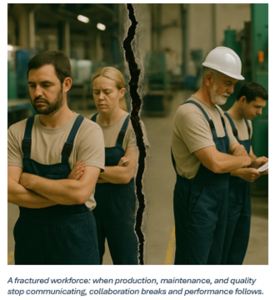
Favoritism creeps in quietly. Certain operators get the preferred shifts or easier assignments while others carry the tougher load. Advancement becomes tied to relationships instead of contribution. The floor sees it, and cynicism grows. When operators witness shortcuts such as sending out borderline product because “the customer won’t notice,” they internalize the message that quality is flexible. Soon they cut corners on checks, documentation, or sanitation because the standard has clearly shifted.
Over time, people stop trying. Innovative ideas to reduce setup time or cut down time go nowhere, and operators learn that their input doesn’t matter. Even strong performers eventually realize extra effort is invisible. They disengage, contribute less, or quietly withdraw. Attendance softens. People show up physically but not mentally, and quiet quitting becomes the norm.
The only reliable way to unwind this is to change how leadership behaves. In our work, the turnaround begins with coaching supervisors and managers directly in their day-to-day routines: how they run meetings, explain problems, give feedback, and enforce standards. Most are not malicious. They are inexperienced, and when shown a better model, they adapt quickly.
But when behavior does not shift despite support, the response must be decisive. Leaders who continue to blame, hide issues, or treat people unfairly are moved out of those roles. That single action often resets norms faster than any corporate culture initiative. Their replacements are people who already have credibility on the floor, individuals trained in root-cause thinking, calm communication, and disciplined follow-through.
Once this leadership layer behaves differently, day after day, culture stops being a slide deck and becomes the way work is done.
At that point, even strong leaders struggle, because they are trying to manage complexity with paper, memory, and manual workarounds.
Misconception 7: “We tried one of those scheduling apps, too much work, the floor guys can’t even use Excel, we’re fine with paper.”
Many teams dismiss digital tools because previous attempts were poorly rolled out with extra clicks, annoyed supervisors, and operators who felt the system was built for the office, not with the floor. The line keeps running, paper works, and no one wants another tool that collapses after two frustrating weeks.
But this resistance often stems from poor implementation rather than the tools themselves. Plants end up stuck in manual chaos that amplifies everyday problems like paper schedules needing update, absenteeism triggering long phone chains, and who-can-run-what living in supervisor’s heads. These tasks are technically doable, but they consume hours of Excel tinkering, constant chasing to fill gaps, and guesswork when assigning people to roles.
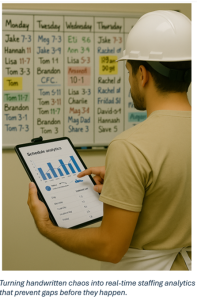
What digital tools do well is remove this drag. Automated schedules, real-time coverage alerts, and a shared view of skills eliminate the admin burden so supervisors can focus on running the floor. Even in low-tech environments, the rollout becomes useful because it forces teams to clarify rules and decision paths, the “What do we do when this person calls out?” logic that was never written down.
We’ve encountered this in a multi-line snack facility where staffing and absences were managed by scribbled lists and last-minute calls. Absenteeism hovered at 25% and overtime was constant. The team viewed any software as another headache. We piloted a $99/month cloud tool on one line, but this time the supervisors helped shape how it worked. Within a quarter, absenteeism dropped 50%, overtime fell, and the nightly coverage scrambled and faded.
When a low-cost, operator-friendly tool is introduced with the floor instead of to the floor, the friction disappears and the performance improvements follow.
These misconceptions don’t just shape culture. They cap plant capacity. The capability already exists on the floor. What’s missing is alignment. In Part 3, we’ll examine misconceptions about physical assets and how they quietly limit performance.
Authors

Ozan Ozaskinli
Partner and Managing Director
Ozan.Ozaskinli@valuegeneconsulting.com

Jordy Lemus
Implementation Manager
Jordy.Lemus@valuegeneconsulting.com

Sercan Aldatmaz
Principal
Sercan.Aldatmaz@valuegeneconsulting.com