

Step inside almost any food manufacturing plant today, and you’ll hear familiar objectives echoing across the production floor: “We need to boost throughput, cut costs, scale faster.” Yet despite the drive and the investment, the numbers tell a harder truth: Manufacturing productivity in the U.S. has not kept up with that objectives.
By Ozan Ozaskinli, Jordy Lemus, and Sercan Aldatmaz
1. Introduction
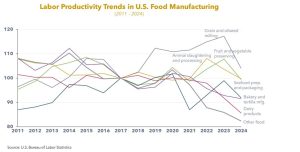
Labor productivity in U.S. food manufacturing, measured as output per hour, has declined by roughly 6% since 2011 (U.S. Bureau of Labor Statistics), even as companies have poured billions into automation, analytics, and efficiency programs. Incremental automation and lean initiatives have delivered small gains, but these are often erased by rising complexity, supply chain volatility, and an increasingly fragile workforce.
This stagnation extends across nearly all major food manufacturing sectors. Only Grain and Oilseed Milling achieved relatively consistent productivity gains, while Bakeries, Dairy, and Other Food Products trended downward. Seafood Processing remained volatile year by year, reflecting variable inputs and seasonal labor pressures. Overall, the food industry’s productivity has not improved, underscoring how technology adoption has far outpaced operational impact.
The industry faces a widening talent gap. Almost half of food manufacturers (47%) say the lack of qualified candidates is their top challenge, and 40% report more overtime due to labor shortages (Impact Staffing, 2024). One in five facilities (20.6%) cannot run at full capacity because of missing skills (SCMR, 2024). Turnover keeps climbing, hitting 26.3% across manufacturing and 27.3% in food manufacturing (Manufacturers Alliance, 2024).
As experienced operators retire, they take critical knowledge with them. Younger workers often step in lacking problem-solving or cross-functional coordination, largely because many facilities still rely on outdated onboarding or job-shadowing models that fail to transfer that knowledge effectively.
Artificial intelligence (AI) and robotics promise to reshape food production. Yet for most manufacturers, large-scale adoption remains years away as integration across production environments proves more complex than expected. AI is improving planning and coordination, but without robotics its impact on the shop floor remains limited. Robotics, in turn, remains confined to narrow, task-specific roles rather than full production-line automation, leaving much of the sector’s automation potential unrealized.
Robotics capable of true end-to-end execution, replacing complex human tasks across production environments, may still be 5 to 10 years away, but it is the direction the industry must move toward, and one the U.S. will need to lead to shape its Next Industrial Revolution.
These trends point to two clear realities: first, food manufacturers must strengthen efficiency and process stability today; second, they must free up capital and capability to invest in the future systems that will define the Next Industrial Revolution.
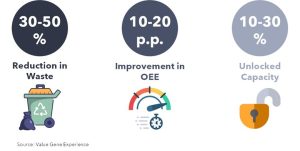
At Value Gene Consulting, we see every day how much opportunity exists to build that foundation. Even in well-run plants, substantial gains are hidden in the details of daily execution. Across our projects, we consistently uncover ways to cut material waste by 30–50%, raise OEE by 10–20 percentage points, and unlock 10–30% additional capacity, often with little to no new capital investment. These results don’t come from large-scale or expensive automation; they come from improving how work is structured, executed, and governed on the factory floor.
2. Misconceptions
The real question, then, is not what food manufacturers are struggling with; we know the challenges well, but why do these problems persist despite so much effort, investment, and innovation. The answer lies beneath the misconceptions.
Misconceptions aren’t operational errors; they’re errors in understanding. They’re the assumptions, habits, and legacy mental models that define how work is managed, measured, and improved. Over time, these beliefs harden into “the way we do things,” even when the environment, workforce, and technology have moved on.
We see it every day:
• Process improvements raise line speeds without adjusting staffing, driving overtime and burnout.
• New equipment is launched without proper retraining, creating instability and frustration.
• Targets are set on wishful thinking rather than data, prompting shortcuts and finger-pointing when performance slips.
Each of these seems like a small operational glitch, but together they form a pattern, a cycle of short-term improvement followed by long-term stagnation. Companies invest, reorganize, and automate, yet productivity barely moves because the underlying logic hasn’t changed.
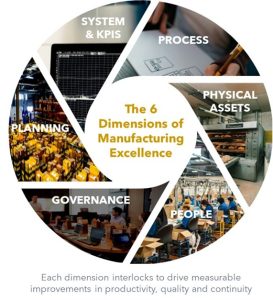
At Value Gene, we’ve learned that behind every persistent inefficiency, unplanned downtime, waste, or unstable throughput, there is always a misconception driving it. These misconceptions act like hidden filters, shaping decisions across six dimensions of manufacturing performance: Process, Physical Assets, People, Governance, Systems & KPIs, and Planning.
3. What’s Next: Breaking the Misconceptions
This is why we created Breaking the Misconceptions, a series dedicated to exposing hidden assumptions that quietly limit performance across the food manufacturing. Operational excellence doesn’t fail for lack of commitment, tools, or technology. It fails because the teams keep solving symptoms instead of causes.
The path forward isn’t another initiative or system. It’s clarity. By identifying and reframing these misconceptions, food manufacturers can reveal the capacity, resilience, and efficiency already sitting within their operations.
Over the coming articles, we’ll dive into the six dimensions that shape every manufacturing system: Process, Physical Assets, People, Governance, Systems & KPIs, and Planning. Each hides its own set of false beliefs that stall improvement and dilute results.
Authors

Ozan Ozaskinli
Partner and Managing Director
Ozan.Ozaskinli@valuegeneconsulting.com

Jordy Lemus
Implementation Manager
Jordy.Lemus@valuegeneconsulting.com

Sercan Aldatmaz
Principal
Sercan.Aldatmaz@valuegeneconsulting.com